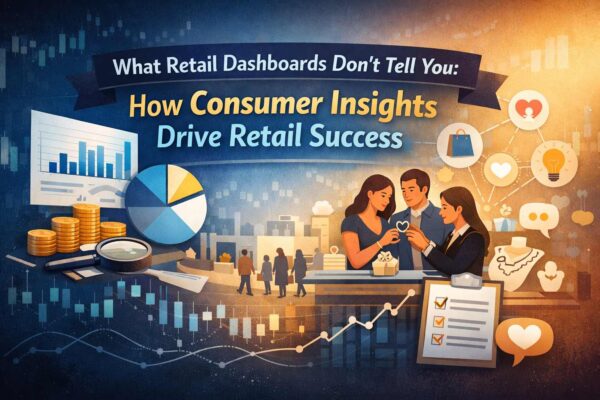
What Retail Dashboards Don’t Tell You: How Consumer Insights Drive Retail Success
How Consumer Insights Drive Retail Success Beyond Dashboards
The key in Business success is to observe the consumer’s insights and execute those insights to build and scale business.
Most retailers monitor the key retail metrics on their dashboard daily to track the operations.
However, success normally lies behind those dashboards.
learn about Retail Myths, click here.
Consumers insights in retail
Let me explain by giving a jewellery brand example.
Dashboard data captured – Rings sold 1000 pcs; Bridal jewellery – 220 pcs; necklaces – 100 pcs
Above is only the sales data that shows – which assortment got sold in a month.
However, the success lies in digging these data sets further into Quantitative analysis i.e.
- How many rings got sold in single invoice?
- Sales contribution of new collection vs others.
- Which products are generally bought together?
Qualitative feedback from store personnel i.e.
- For what occasions did the customer bought jewellery? (Moment of consumption)
- Did the customers come solo to shop or they come with partners or family?
Customer behavior insights
Today in uncertain and volatile market dynamics, retailer cannot ignore the importance of research and data insights.
One such jewelry brand which addressed the above issue is , The Brillant Earth.
Data from The Brilliant Earth found that, in 2025, the number of couples who shopped for engagement rings together crossed 50%.
The biggest category contribution came from Bridal collections.
Learn as to why Private label brands mean more for hypermarkets, click here.
Using data insights into campaigns and New Product development
Brilliant Earth started hosting “Date Nights” for couples shopping together.
The Date Nights featured a personalized walkthrough of jewelry options and the opportunity to design a ring, but with added features like food, drinks, music and time alone in the store.
In addition, the company has begun hosting Bridal Collectives — quarterly in-store events held at various Brilliant Earth showrooms that include a product collaboration with a creative or influencer, as well as a curated edit of products.
Experiential retail strategies for jewelry brand
- Create instore engagement and a third space for shoppers seeking exclusivity for their special big day (wedding/engagement etc).
- Tapping innovative ways people shop for jewelry.
Turning retail data & consumer insights into business growth
Brilliant Earth has been on a positive streak in recent years. In November 2025, it reported its 17th consecutive quarter of positive growth, with net quarterly sales up 10% year over year to $110 million.
Follow me on Linkedin, click here
About the author:
Ritesh Mohan is a retail and business strategist specializing in international retail expansion, franchising, brand building, and P&L-led growth for fashion, beauty, and fragrance brands.
Retailers who want to grow and scale their businesses and need a helping hand to make their vision into reality may reach out to me directly by mailing me at riteshmohan@yahoo.com
I help retailers & businesses with:
- Sales training,
- location scouting and analysis,
- product launch strategies,
- new product development and market studies,
- retail operations,
- Ecommerce strategies and
- franchising infrastructure development.
- Market research and Data insights (in collaborations with E2E)